The Use of Cosmetics in Nineteenth Century France 

The use of cosmetics during the late nineteenth century in France was a highly contentious issue in society with ardent support from some and intense criticism from others. Although cosmetics had been used in the West for centuries, it remained an issue that prompted great debate as to who ought to wear cosmetics and how it should be worn. Women who chose to wear cosmetics in daily life were almost certainly considered to be New Women due to the artificiality of makeup as a way of altering their true appearance, and because of the allusions to actresses and prostitutes that arose from these products. This article shall begin by analysing women wearing lipstick through analysis of Anquetin’s Elégante à l’Elysée- Montmartre from 1888 (Figure 1), followed by a study of the use of face powder in his Woman in a Hat from 1890 (Figure 2). There have been few detailed studies on the importance of cosmetics in ascribing identity to modern women in fin-de-siècle Paris, and as such this chapter intends to tackle this with an examination of Anquetin’s intentions when portraying women wearing cosmetics.


ij
Figure 1.                                                                                          Louis Anquetin, Elégante à l’Elysée- Montmartre 1888.


Continue reading “The Use of Cosmetics in Nineteenth Century France “

What makes a blockbuster a good exhibition?

I have always been really interested in the idea of a ‘blockbuster’ exhibition. Do I enjoy them, or do I think of them as a necessary evil? I’m still not entirely sure. While looking into current and upcoming exhibitions in London, I find myself exlcaiming out loud, “another exhibition on him?!” I recently wrote about the phenomenon of the blockbuster, and thought I’d share my views. Of course, they make galleries more accessible to the public and bring in crucial cash, but are these money-making, name-grabbing exhibitions guilty of oversimplifying and commodifying artworks in our public collections?

Continue reading “What makes a blockbuster a good exhibition?”

Lesbianism in Late Nineteenth Century Paris

I have recently been looking back over my writing and thought as it is Pride Month, it would be a perfect time to share this essay on the depiction of lesbianism both inside and on the streets of late nineteenth century Paris. I edited out a part of the ‘Outdoor’ section, so it is much shorter than the ‘Indoor’ section. I’d like to write my PhD on Anquetin, so I would like to write something longer about him and his scenes of lesbianism in the streets of Paris. Consider this to be a taster!


  1. Introduction

During the late nineteenth century, the notion of female sexual impulse was not universally accepted; despite this, Paris remained the lesbian capital of the fin de siècle period in France.[1] Discourse on lesbianism arose in the early nineteenth century with Alexandre Parent du Châtelet’s study La Prostitution dans la ville de Paris in 1936, in which he asserts lesbianism as a phenomenon of prostitution.[2] It was not until 1890 when lesbianism was first described as a chic urban vice rather than a form of prostitution, in Ali Coffignon’s text Paris Vivant: La corruption à Paris.[3] While erotic scenes that take place behind closed doors are often blatantly sexual, lesbian scenes on the streets of Paris are far more discrete in order to preserve bourgeois morality of sexual misbehaviour taking place in public. This creates a juxtaposition between where lesbian women are visible, and who they are visible for- interior, erotic scenes are acceptable for heterosexual male consumption; whereas lesbians searching for other women on the streets are indulging in social decadence and moral corruption by renouncing their traditional roles of wife and mother.

Continue reading “Lesbianism in Late Nineteenth Century Paris”

Gustave Caillebotte and depictions of homosexuality

Much has been written on the artist Gustave Caillebotte and his depictions of modern life in Paris during the late nineteenth century. There has been very little written about his sexuality, which has always fascinated me as I think the way in which he depicts men is incredibly homoerotic and shocking for the period. Notably, I believe that Caillebotte’s Le Pont de l’Europe from 1876 (Figure 1) may show the perspective of a homosexual male artist painting male homosexuality and thus offers an important insight into homosexuality during the Third Republic.[1] This painting can offer a link between the experience of homosexual women and homosexual men during the Third Republic in France- it demonstrates a life of secrecy and caution as homosexual men attempt to find other homosexuals.

caill
Figure 1. Gustave Caillebotte, Le Pont de l’Europe, 1876. Oil on canvas. Musée du Petit Palais, Geneva.

Continue reading “Gustave Caillebotte and depictions of homosexuality”

The Rockefeller Sale and the Importance of Great Provenance

The importance of provenance at auction has always been of great interest to me: the way in which a single owner can drastically alter an object’s financial value. The recent Rockefeller Sale at Christie’s New York naturally peaked my interest then, being lauded as the first single collection at auction to make a billion dollars. Ultimately it did not achieve that (almost ridiculous) amount, but it did still take the record for the most money ever made from a single collection: $832,600,000. Almost double the previous record of $443 million from the collection of Yves Saint Laurent and Pierre Berge in 2009. The sale lasted ten days with online and live auctions, with all of the proceeds going to charities supported by Peggy and David Rockefeller during their lives.

Matisse
Henri Matisse, Odalisque Couchee aux Magnolias, 1923.                              Source: www.artnews.com

Continue reading “The Rockefeller Sale and the Importance of Great Provenance”

Review: Impressionists in London: French Artists in London, 1870- 1904, Tate Britain

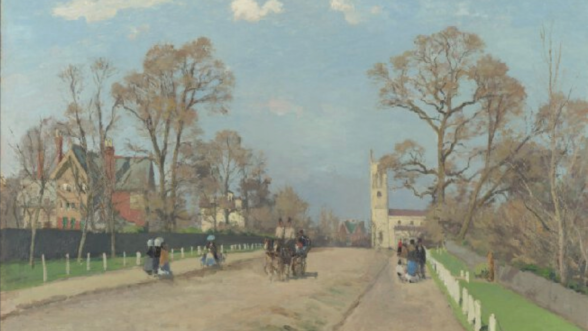
‘Impressionists in London: French Artists in Exile 1870- 1904’ is the current blockbuster exhibition at Tate Britain that is cashing in on art historical buzzwords and big names. The problem is, a lot of the works in this show are not strictly Impressionistic, and those that are, are not painted by an artist in exile. The show began with a historical account of the Franco-Prussian war, before several rooms dedicated to individual artists and their experience of living in London during this period.

Capture d’écran 2018-02-11 à 18.13.43.png
Camille Pissarro, The Avenue, Sydenham, 1871

Continue reading “Review: Impressionists in London: French Artists in London, 1870- 1904, Tate Britain”

Review: Andreas Gursky, Hayward Gallery

IMG_1793.jpg
Figure One. Andreas Gursky, Zurich I, 1995.

Andreas Gursky, possibly the world’s most celebrated photographer, receives his first major retrospective in the United Kingdom at the Hayward Gallery, which has just opened after its two-year refurbishment. Many of the artist’s best-known works form part of the sixty photographs on show, as well as a selection of his earliest and newest works. The show was curated by the gallery’s director Ralph Rugoff, and chronologically traces his career across ten rooms. The gallery’s open space and clean white walls allows attention to fall on the spectacular detail and depth of his work, which is particularly challenging due to the fact that many of the artist’s photographs are larger than three metres in length. The show’s careful curation affords each photograph with space to breathe, ensuring that you can take in the depth and complexity of each composition without being overwhelmed by the mass of visitors- who ironically demonstrate Gursky’s commentary on crowds and humanity’s increasing occupation of space in the world.

Continue reading “Review: Andreas Gursky, Hayward Gallery”